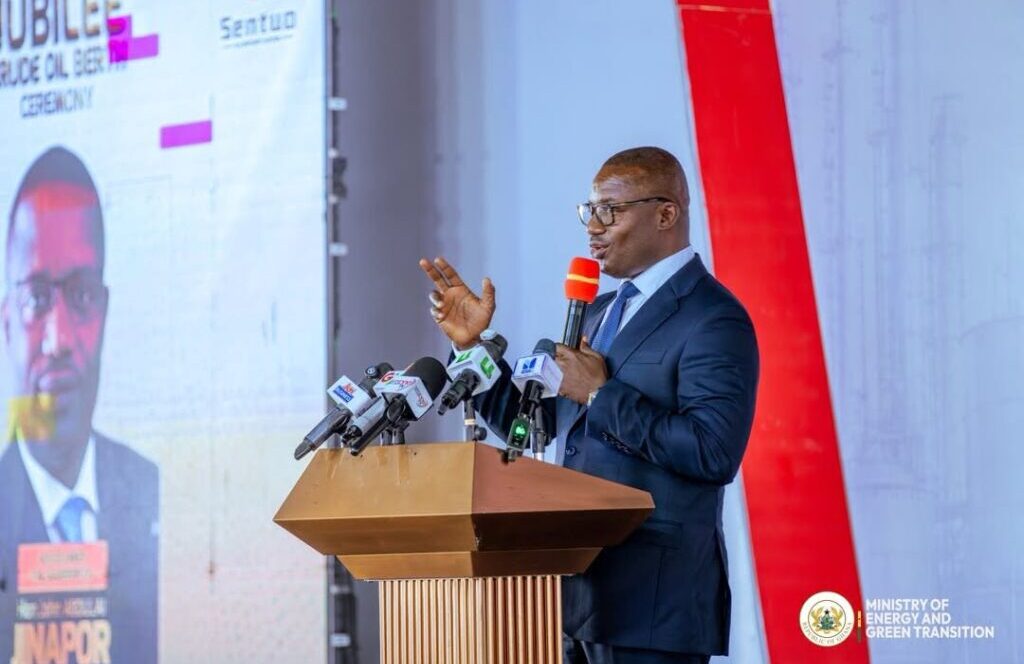
The Minister for Energy and Green Transition, Dr John Abdulai Jinapor, has outlined plans to accelerate Ghana’s transition towards cleaner and more sustainable energy, identifying renewable energy expansion, mini-grid projects and the advancement of the Ghana Nuclear Power Programme as key priorities for 2027.
He said the government remained committed to diversifying the country’s energy mix, expanding electricity access and strengthening the resilience of the national power system to meet the country’s growing energy needs.
Addressing the 2026 Energy Sector Performance Review Retreat, Dr Jinapor said the Ministry and its agencies must move beyond planning and focus on delivering measurable results in the coming year.
“As we look towards 2027, therefore, our focus must be clear: from plans to implementation; from commitments to measurable results; and from promises to delivery,” he stated.
The minister identified the expansion of solar and other renewable energy projects, completion of 35 mini-grids, expansion of solar home systems and net-metering, and promotion of clean cooking initiatives as priority areas requiring accelerated implementation.
He also stressed the importance of advancing the Ghana Nuclear Power Programme as part of efforts to establish a more diversified and sustainable energy system.
According to Dr Jinapor, renewable energy capacity had increased to 345 megawatts, while the country’s installed electricity generation capacity stood at 5,854MW. Electricity access had also risen to 89.13 per cent.
He said these developments demonstrated progress in expanding the country’s energy infrastructure but noted that more work was required to ensure reliable electricity supply and improve access across the country.
The minister emphasised that the transition to cleaner energy must go hand in hand with investments in generation, transmission and distribution infrastructure to ensure that electricity could be delivered efficiently to homes, businesses and industries.
He also called for stronger institutional coordination and accountability, insisting that agencies must clearly define their targets, resource requirements and implementation timelines for 2027.
“Every Agency must clearly state what it achieved in 2026, what it intends to achieve in 2027, the resources required, and the timelines for delivery,” he said.
Dr Jinapor further urged the agencies to ensure that all projects were implemented in accordance with procurement laws and regulations, stressing that the pursuit of faster delivery must not undermine transparency, accountability or value for money.
He said the government’s energy agenda was aimed at building a system that could withstand external shocks while supporting industrial development and economic growth.
“Above all, let us deliver an energy sector that is reliable, affordable, sustainable and resilient, and that supports the economic transformation of Ghana,” he stated.
The 2026 Energy Sector Performance Review Retreat is expected to provide a platform for the Ministry and its agencies to assess their performance during the year, review outstanding commitments and agree on measurable targets and priorities for 2027.