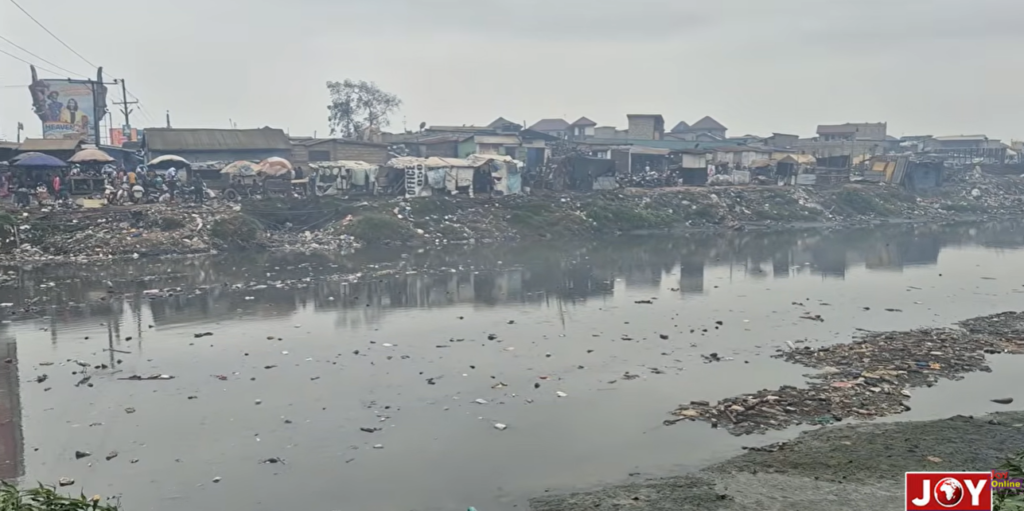
A month after floods tore through Accra, JoyNews Explains went looking for one of the quieter culprits behind the crisis: the everyday filth sitting in the city’s markets, drains, lorry stations, and roadsides. It didn’t take long to find it.
But this isn’t just a story about rubbish. It’s a story about GH¢2.03 billion.
That’s how much government has collected since 2021 through the Sanitation and Pollution Levy, a 10 pesewa charge on every litre of petrol and diesel sold in the country, introduced under the Energy Sector Levies Act. The levy was designed to fund a specific set of interventions: improving air quality, building and upgrading waste treatment facilities, supporting landfill management, running fumigation and disinfection exercises, and constructing sanitation facilities to help eliminate open defecation.
According to Finance Ministry data, GH¢1.51 billion of that had been spent by the end of 2024. The breakdown shows where the money actually went: about 80 percent roughly GH¢1.2 billion, was spent maintaining landfill sites and waste treatment facilities. Around GH¢100 million went to improving air quality, GH¢95.9 million to fumigation and disinfection, and GH¢74.7 million to waste treatment infrastructure.
One figure stands out: GH¢0 was spent on constructing sanitation facilities to eliminate open defecation, despite that being one of the levy’s own stated core objectives.
As for the GH¢298 million collected in 2025, there is no official account yet of how it has been used. As of the end of 2024, the Sanitation and Pollution Account held GH¢180.5 million. Adding the 2025 collections suggests the account could now hold roughly GH¢478 million, assuming no additional withdrawals have been made.
The clean-up that raised a legal question
In the aftermath of the floods, President John Dramani Mahama declared Friday, July 10, and Saturday, July 11, 2026, as National General Cleaning Days across the seven regions affected, urging citizens to take part in a nationwide clean-up exercise aimed at improving sanitation and preventing disease outbreaks.
The directive quickly ran into a legal challenge. Private legal practitioner, journalist, and host of Joy FM’s Newsfile, Samson Lardy Anyenini, argued that compelling citizens to participate in the exercise was not backed by any national law empowering the President to enforce such a directive. Anyenini noted that unless a specific assembly has a by-law mandating the exercise and a person is found in breach of it, forcing anyone to participate would be legally wrong.
Two failures, not one
What JoyNews Explains found in this episode is a story with two sides. On one hand, there’s a real accountability question: hundreds of millions of cedis collected specifically to fund sanitation infrastructure, with core objectives like ending open defecation, left completely unfunded.
On the other hand, much of the filth the team filmed across Accra’s markets, drains, and streets wasn’t sitting there because of a funding gap. It was there because someone chose the ground over a bin. That part costs nothing to fix, and doesn’t require a directive, a levy, or a law to correct.
As the report puts it: it’s not one failure. It’s two. And only one of them costs money to fix.
Watch the full explainer above, and share this with someone who needs to see it.
JoyNews Explains is a JoyNews production breaking down the stories shaping Ghana, simply and honestly. Watch our previous episodes on [Accra’s 66-year flooding history] and [the city’s encroachment crisis].