
Investigative journalist and coordinator of the civil society-led Pledge Against Corruption campaign, Manasseh Azure Awuni, has filed a right to information (RTI) request to the Judicial Service, asking for detailed timelines of Sedina Christine Tamakloe Attionu’s appeal.
Sedina Tamakloe, the Chief Executive of the state-owned Microfinance and Small Loans
Centre (MASLOC) from November 2013 to January 2017, was acquitted and discharged by the Court of Appeal on July 30, 2026.
She was convicted and sentenced to 10 years in prison by the High Court (Financial Crimes Division) on April 16, 2024, after a trial in absentia. She had failed to return to Ghana after the court granted her permission to seek medical care in the United States.
She had been charged with seventy-eight counts of Conspiracy to Steal, Stealing, Conspiracy to Willfully Cause Financial Loss to the State, Willfully Causing Financial Loss to the State, Causing Loss to Public Property, Improper Payment of Public Funds, Money Laundering, Unauthorised Commitment Resulting in Financial Obligation for the Government and Contravention of the Public Procurement Act.
On May 9, 2024, while she was still at large, court records indicate that Sedina challenged her conviction at the Court of Appeal, which acquitted her after she was repatriated from the United States in June 2026 to serve her sentence.
While the Court of Appeal judgment has generally been received as sound, doubts still linger in the minds of a section of Ghanaians about the timelines of her appeal. Though the Appeal was said to have been filed in May 2024, the Attorney-General’s Department is said to have been notified only in February 2026, fueling conspiracy theories about possible underhanded dealings.
The Attorney-General and Minister of Justice from 2021 to January 2025, Godfred Yeboah Dame, said in a press statement that he had not heard about Sedina’s appeal at the time he left office.
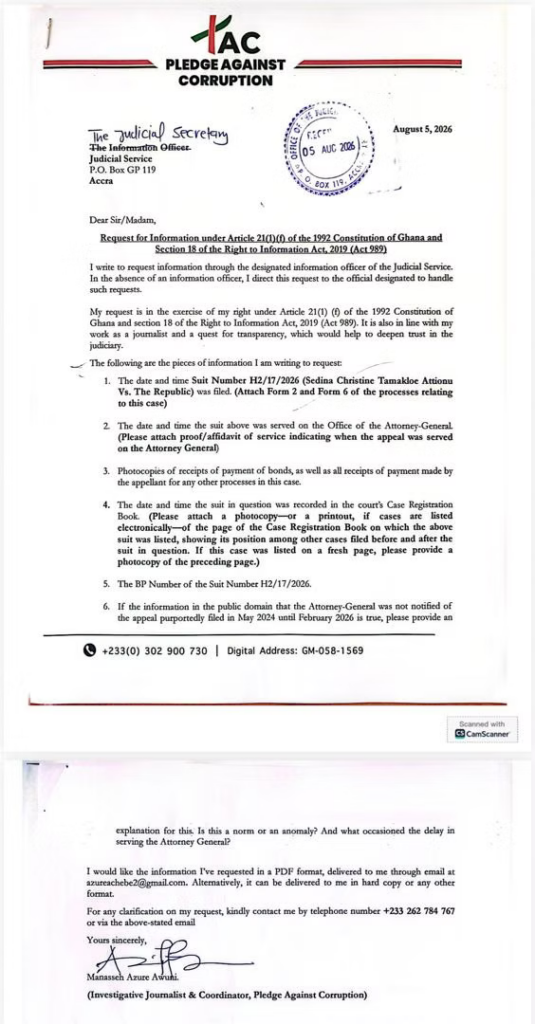
Manasseh’s RTI request of the Judicial Service seeks to lay the matter to rest. It seeks an explanation of the nearly two-year delay in notifying the Attorney-General’s office of the appeal, as well as key evidence of the filing timelines.
Manasseh requested the following information from the Judicial Service:
1. The date and time Suit Number H2/17/2026 (Sedina Christine Tamakloe Attionu Vs.
The Republic) was filed. (Attach Form 2 and Form 6 of the processes relating to this
case)
2. The date and time the suit above was served on the Office of the Attorney-General. (Please attach proof/affidavit of service indicating when the appeal was served on the
Attorney-General)
3. Photocopies of receipts of payment of bonds, as well as all receipts of payment made by the appellant for any other processes in this case.
4. The date and time the suit in question was recorded in the court’s Case Registration Book. (Please attach a photocopy—or a printout, if cases are listed electronically—of the
page of the Case Registration Book on which the above suit was listed, showing its
position among other cases filed before and after the suit in question. If this case was
listed on a fresh page, please provide a photocopy of the preceding page.)
5. The BP Number of the Suit Number H2/17/2026.
6. If the information in the public domain that the Attorney-General was not notified of the appeal purportedly filed in May 2024 until February 2026 is true, please provide an
explanation for this. Is this a norm or an anomaly? And what occasioned the delay in serving the Attorney General?
According to Manasseh, the RTI request, which was submitted to the Judicial Service on August 5, 2026, “is in line with my work as a journalist and a quest for transparency, which would help to deepen trust in the judiciary.”