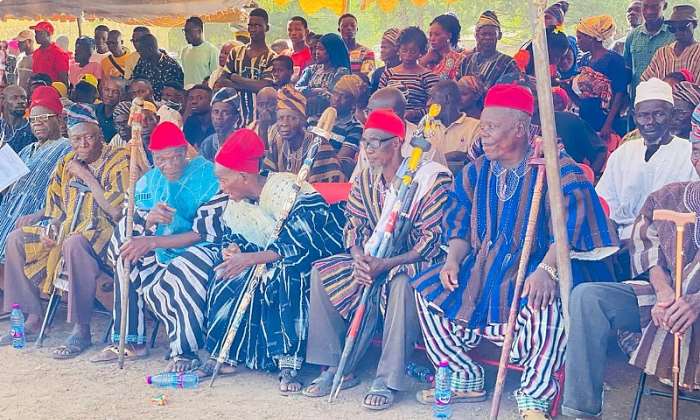
Kunlog is a Vagla community near Sawla in Sawla-Tuna-Kalba District of the Savannah Region of Ghana. Kunlog is believed to be the second oldest Vagla Community, the second to be settled when the Vagla Tribe originally migrated from Sissala Land. The Vagla first settled in Jang, then migrated to Kunlog before moving farther southward to Dagbigu and Beel to establish their chiefdoms, with their deities and land pacification, among others, as custodians of the Land. The Supreme Traditional Ruler or Chief of Kunlog is Kunlog Heuhin, with the appellation of Siayo.
The Kunlog Heuhin traditional powers cannot be challenged by any other traditional ruler. The shrines and deities are all under the control or auspices of the Kunlog Heuhin. The Kunlog Heuhin performs the rite of the Supreme Earth Deity as the Kunlog Heu. The Kunlog Heuhin is the source of other deities, including Kacha-Na, the Kunlog Polzen, Holzen-Zee, the Nyange Shrine/Deity, and others within the Vagla Kunlog Traditional Area. But with time, the Kunlog Heuhin relegated or delegated some of the roles to other Elders or Leaders of Kunlog to pacify some of the areas.
Kacha-Na is the name of the deity. The traditional leader or office holder is Kacha-Hin or Kacha Koro. Immediate past Kacha-Hin: Sunwanee Vug (Konberi), and the current is Chorsor Moshie.
The clan or gate who ascend to the office of Kach-Hin or Kacha Koro is Banchi-Sal (gate). The office of Kachahin or Kacha Koro revolves around the elders of Banchi-Sal in Kunlog. The eldest or the most suitable candidate is usually selected by the Banchi-Sal elders, and the nominee is introduced to the Supreme Traditional Ruler, the Kunlog Heuhin. The Kunlog Heuhin approved and announced the Kachahin. It is important to note that there is a Council to the Kachan. The Council consists of at least one elder of each of the three gates, namely Kori-Sal, Sabizi-Sal and Banchi-Sal. These constitute the Council of the Kacha, who also performed the rituals of the Kachana. This shows that the office of the Kachana is not a one-man show, but it operates as three in one.
All three Royal Gates have a representation in the Kacha Council, and all three gates are and must be part of the rituals that pertain to the Kachana Festival of Kunlog. The representatives of the three gates will all follow and support the Kachahin to perform the Kachana rites. The three-in-one principle is unique to the Vagla Chiefdom and aligns with the customs and practices of the Vagla people. The principle also serves as a form of checks and balances on the office holder (the Kacha-hin).
It prevents dictatorship and promotes unity in diversity of the three gates, who all remain loyal to the Kacha-Na (deity) for the best interest of the people, the land and for the prosperity of the Kunlog Village. The traditional office holder observes several taboos on behalf of the Vagla people of Kunlog. The other elders or gatekeepers to the Kacha-Na also strictly observe the taboos of the Kacha-Na. Hence, the performance of the Kachana Festival is very revered in the Vagla Community. These taboos make Vagla Chiefs unique- the true Custodians of the Land.
The Kunlog Heuhin remains the highest traditional ruler with power over all traditional positions within the Vagla Kunlog Traditional Area. The traditional event is called the KACHANA FESTIVAL. Kachana Festival is one of the most celebrated festivals of the Vagla people of Kunlog near Sawla. Kachana Festival is a highly revered traditional rite or festival which is usually performed twice every year in the Vagla Village of Kunlog.
The first and the second both mark the consumption of a new crop. Thus, the Kachana festival assumes two forms; the first part assumes higher importance.
The First Kachana Festival is the most celebrated; it is linked to New Yam Consumption. This New Yam Consumption in Vagli is called Hee-Fali-Di (new yam) or Kabila-Fali-Di (new fufu consumption). Many people from far and near visit the Vagla Village of Kunlog for the New Yam boom there. This offers an opportunity to freely consume the new yams, which are free for people and available in various homes. The Kacha Festival is very interesting because every house in the village is busy with new yams and the associated meals like the Pounding of Fufu (using Pestle and Mortar). Besides the consumption of fufu, the visitors to the village are freely given a lot of yams to carry to their respective villages/towns. The festival is beautifully marked with the dances of the various women’s groups in Kunlog who put on their best clothes to celebrate the Kachana Festival. There is also a series of dances in Kunlog village, both traditional dances, including Janse and other modern music like brass band music and youth groups and some local musicians’ performances at concerts; all these dances and music are performed to mark the Kachana Festival.
Some significance of the Kachana Festival of the Vagla People of Kunlog in the Savannah Region
One significance of the Kachana Festival is that the people of the village do not eat new yams in the village until rituals are performed. This long period of observance of the taboos (not to eat new yams) or not to consume new yams is to help the yams grow better. Also, the long period of the taboo helps the yam farmers to be able to sell their yams in ‘silos’ (large quantities) for more money. Furthermore, the people of Kunlog and beyond come to take vows or oaths for a good yield and come back to renew such vows or oaths. All these involve multiple pacifications of the Kacha-Na at home and at a sacred site outside the village.
The celebration of the revered Kachana Festival adds to the preservation of the rich cultures and customs of the Vagla tribe of Northern Ghana. Vagla are the ABORIGINES OF THE NORTH (originated from the North), most Vagla rites are land-related, many linked to good harvest and the fortunes of the land. Also, the culture is environmentally conscious, such that the people are forbidden from early yam consumption. Also, they are forbidden from eating wild animals like Antelopes (‘Nagin’/ ‘Chankpalinga’). These cultural practices helped to conserve/protect wild animals, which are closer to Ghana’s largest Wildlife Park, called the Mole National Park. The second part of the Kunlog Kachana Festival is celebrated towards the dry season to mark the beginning of the harvest of Millet and for millet consumption. There must be a ritual to mark the beginning of the consumption of millet or the use of millet to brew the local fermented drink Pito. The millet ritual must be performed before the people of Kunlog, especially the clan elders of Kacha-Na, can consume/eat millet as food or Pito. This millet rite is the second Kachana Festival. It is usually celebrated with a low profile compared with the first part- New Yam (Hee-Fali or Kabila-Fali). Until the millet rites are performed, prominent traditional Chiefs such as Kacha-Koro/Kacha-Hin, the elders of Banchi-Sal, and Kacha Council members cannot consume new millet. New millet era Kacha-hin cannot travel.
Credit: JK Ahiah, Historian and Educationist and Robert Vug Siakoni, An Elder from Kunlog